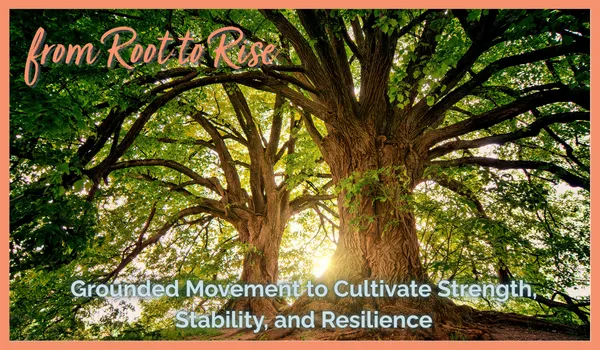
Root to Rise: Grounded Movement to Cultivate Strength, Stability, and Resilience
Ah yes! Spring is in the air 🐝🌦☀
One of the things I love about Spring… is the fact that so much is happening beneath the surface. Long after the snow is gone, the leafless trees remain spindly looking… the Earth relies on her unwavering trust in the process of cycles.
In spring, growth doesn’t begin with what we see above the surface. It begins with the roots.
Before anything blooms, there is a quiet awakening happening below the surface… beneath what it seen. Here is where stability, support, and resilience is being rooted in and fortified.
The same holds true for you AMAZING and beautiful body!
Why Foundational Strength Matters
Your skeletal system provides the structure that supports everything you do. And like roots anchoring a tree, your bones and joints rely on consistent, supportive loading to stay strong.
Bones are living tissue, constantly breaking down and rebuilding in response to how you use your body. When you engage in weight-bearing and resistance-based movement… like walking, squatting, lifting, or pushing… you stimulate bone-forming cells (osteoblasts) to lay down new tissue. This process helps maintain and can even increase bone density over time, making your skeleton more resilient and adaptable.
Without this type of stimulation, the body begins to conserve energy by reducing bone density. This can happen gradually and often without noticeable symptoms at first. Research shows that adults can lose 1–3% of bone mass per year after the age of 30 if strength-building activities are not part of their routine.
The good news is that this process is not only preventable, but reversible with consistent, appropriate strength practices.
Weight-bearing and resistance-based movements help:
maintain and improve bone density
support joint health by strengthening surrounding muscles
improve balance and coordination
reduce the risk of injury and fractures over time
Even small, consistent strength practices just a few times per week can create meaningful changes in bone health. Over time, this builds a foundation of stability and confidence in how you move through your daily life.
The Role of Fascia in Strength
Fascia doesn’t just support movement, it helps transmit force throughout the entire body. Rather than muscles working in isolation, fascia connects everything into an integrated system. When you push through your feet, reach with your arms, or stabilize your core, fascia helps distribute that effort efficiently across multiple structures.
When fascia is healthy, hydrated, and responsive, movement feels smooth, coordinated, and supported. This is because fascia stores and releases elastic energy, much like a spring, allowing your body to move with both power and ease.
When fascia becomes restricted, due to inactivity, repetitive patterns, or stress, it becomes less efficient. Movement can start to feel disconnected, stiff, or uncomfortable, and more effort is required to do the same tasks.
This is why combining strength practices with fluid, varied movement is so powerful, it restores communication within the body, supporting both strength and adaptability at the same time.
Breath as Your Foundation
Before strength comes stability and balance… and conscious breathing is the best place to start.
Your breath is deeply connected to your core, spine, and overall posture. The diaphragm is not just a breathing muscle it works in coordination with your deep core muscles (including the pelvic floor and transverse abdominis) to create stability from the inside out. Your core muscles are your body’s version of roots.
Research shows that proper diaphragmatic breathing can improve core activation and spinal support, which directly impacts how safe and effective your movements feel. Even simple movements… like standing up, reaching overhead, or walking… can feel more stable and less effortful.
Holding your breath during effort, although this is very common, can actually increase internal pressure and amplify unnecessary tension in the body. This can lead to bracing, fatigue and body strain. Instead, try pairing your breath with movement, such as exhaling as you stand from a squat or as you push away from a wall. This helps regulate joint pressure, improve balance, and reduce excess muscle tension.
You can begin integrating this anytime, anywhere.
For example...
·Try exhaling slowly as you lift groceries, stand up from a chair, or climb stairs.
·Notice how your body responds.
·Your breath has the ability to become a natural support system…helping you move with more ease, stability, and confidence.
·Over time, this simple shift can transform not just how you exercise, but how you move through your entire day.
When you breathe with awareness, your body organizes itself more efficiently.
• your diaphragm engages
• your core responds naturally
• your movements become more supported
A practical way to experience this is by placing one hand on your ribs and one on your belly, taking a slow inhale through your nose, and feeling a 360-degree expansion. This type of breath helps create a strong, responsive foundation for movement.
A “Root to Rise” Practice (10–15 Minutes)
#1 ~ Grounded Breathing (2 minutes)
Stand with feet hip-width apart
Place one hand on your ribs and one on your belly
Inhale through your nose allowing your body to expand 360 degrees…. belly outward and ribs sideways.
Exhale slowly, feeling your feet connect to the ground.
Repeat several more times.
#2 ~ Foundational Strength (5–7 minutes)
Try some of these strength-based movements
Chair or Kitchen Sink Squats (click HERE for a handout).
Lunges (each side).
Wall push-ups.
8-10 reps per movement is a great place to start.
The key is to move slowly and exhale on the hard part of the movement
3. Stability + Balance (3–4 minutes)
Position yourself in front of a wall or behind the back of a chair
Stand upright with your feet together.
Lift right foot off the ground. (try not to have your legs touch as this may give you extra stability).
Record how many seconds you are able to stand on one foot.
Repeat with left foot off the ground.
Try this again with a twist…
Lift right foot off the ground and raise your left arm above your head.
Record how many seconds you are able to hold this stance.
Repeat with Left foot off the ground and right arm raise above your head.
Make note of which side is easier to balance and whether lifting an arm above your head made balancing easier or hard 🤔
NOTE: If you are able to stand with one foot lifted for 60 seconds or longer, try the single leg stance test while standing on a soft surface like a pillow for an extra level of difficulty.
Why This Works
Short, consistent strength and stability practices can:
improve bone density and joint stability
enhance balance and coordination
support fascia elasticity and responsiveness
increase overall energy and confidence
Even 2–3 sessions per week can make a measurable difference in strength and stability.
An Invitation
You don’t need to chase intensity to build strength… truly all that is required is consistency, awareness, and your own permission to connect to the wisdom of your AMAZING body 🧡
Focus on your roots:
how you stand
how you move
how you support your body
… from here everything else rises:
your strength
your balance
your enjoyment in movement
your confidence.
May this spring season fill you with joy, excitement and a renewed appreciation in the capability, strength and wisdom of your body 🤩🧡
Love,